
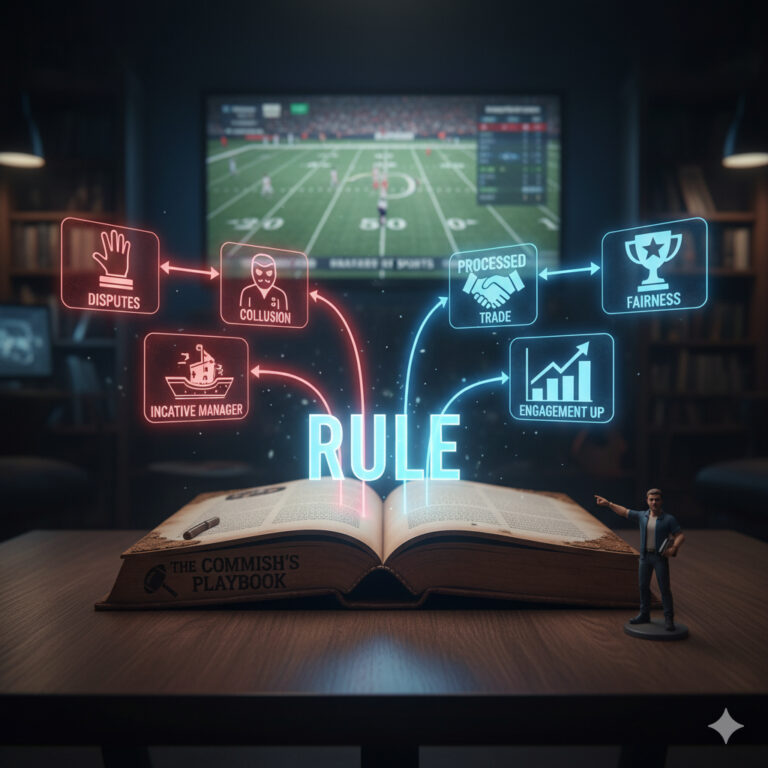
Is your fantasy football league spiraling into chaos? As a commissioner, dealing with constant trade disputes, accusations of collusion, and inactive managers is the toughest part of the job. Stop the drama now with this definitive Commish’s Playbook for settling the most common fantasy football disputes quickly, fairly, and consistently.
Introduction: The Weight of the Whistle
The league chat is usually reserved for trash talk, injury news, and celebratory GIFs, but then Week 7 hits. Two managers just proposed a trade — a star running back for a pair of high-upside backups — and now your phone is blowing up with notifications. Half the league is screaming “Collusion!” while the other half is demanding a league-wide veto.
Welcome to the Commissioner’s office.
As the Commish, you were thrilled to organize the draft and collect the league dues, but once the season starts, your role changes drastically. You become the League Czar, the supreme court justice, and sometimes, the league therapist. The decisions you make — or fail to make — directly determine the integrity and longevity of your league.
The difference between a thriving fantasy season and a drama-filled headache comes down to your ability to handle conflict fairly. This playbook isn’t about being perfect; it’s about being prepared, transparent, and consistent. We’re diving deep into the toughest calls you’ll face: resolving lopsided trade disputes, shutting down claims of collusion and tanking, and managing the frustrating issue of inactive “Ghost Ship” managers.
Follow these principles, and you’ll ensure your league remains fun, competitive, and drama-free for years to come.
Dispute 1: The Lopsided Trade Veto
The single fastest way to kill a trade market and stifle activity in your league is allowing the Tyranny of the Veto to reign supreme. This usually happens when one manager proposes a trade, and suddenly the “trade police” in the group chat are activated. Everyone else votes to veto, not because they suspect cheating, but because they believe the trade is “lopsided” or, more accurately, because it makes a rival team too strong.
Why the League Veto Must Die
The purpose of a veto is not to protect managers from making a bad decision. Fantasy football is about risk and reward; if a manager wants to trade the best running back for a stack of late-season lottery tickets, that is their strategic right. When you allow a full league vote, you are essentially letting managers veto a move because it hurts their chance of winning. This is anti-competitive and creates resentment.
The Solution: Adopt the “Collusion-Only” Standard.
The commissioner should have sole power to review trades, and the only criteria for reversal must be clear and demonstrable collusion (two managers coordinating to cheat) or gross negligence (an abandoned team dumping its stars). Your league should operate under the principle that all trades stand unless proven collusive.
The Commish’s Trade Review Playbook
When a questionable trade lands on your desk, resist the urge to rule based on expert rankings. Follow this two-step process to ensure fairness:
1. Demand Rationale, Not Proof of Value: Reach out to both managers privately and ask them to explain their thinking.
- The Question: “Tell me, in a few sentences, why you believe this trade makes your team better.”
- The Standard: If the manager can provide a rational, defensible argument — even if you disagree with the player valuations — the trade must be approved. For example, trading a star RB for a WR and a QB might seem lopsided, but the manager might rationally argue, “I needed QB/WR depth to cover my bye weeks and make a playoff push, and I have running back depth to spare.”
2. Focus on Collusion, Not Lopsidedness: Only interfere if the explanation is non-existent, nonsensical, or if you have evidence of an external exchange (e.g., cash changed hands, clear roster dumping, or “we agreed to trade the player back next week”).
Your Ruling: When you approve a trade that others call “lopsided,” make a brief, neutral statement to the league: “The trade between Team X and Team Y has been approved. I found no evidence of collusion and both managers provided a rational basis for the deal.” This reinforces your neutrality and the “collusion-only” standard.
Dispute 2: Handling Collusion & Tanking Claims
Collusion is the mortal enemy of fantasy football. It means two or more managers are conspiring to cheat the league for their mutual benefit, usually by stacking one team. While “tanking” (intentionally losing) is often considered poor sportsmanship, it can quickly escalate into collusion when a team that’s mathematically eliminated starts dumping its stars onto a contender for no rational gain.
Preventing Tanking Before It Starts
The most effective way to prevent tanking is to incentivize engagement for every team, regardless of their standing.
- Early Trade Deadline: Set the trade deadline between Weeks 8 and 10. This works because by this point, most teams still have a shot at the playoffs, limiting the window for eliminated teams to dump players.
- Loser Bracket Incentives: Run a separate bracket (the “Toilet Bowl“) for non-playoff teams. Reward the winner of the Loser Bracket with a positive prize (e.g., first choice of draft position next year, or a small cash refund). This gives losing teams a reason to set their best lineup.
- Strict Lineup Policy: Write a rule that mandates a competitive lineup be set weekly. This gives you the leverage to intervene with inactive managers (covered in the next section) and prevent intentional roster manipulation.
Commish Action: The Collusion “Burden of Proof”
Handling a collusion accusation requires cold, hard evidence, not suspicion. Your priority is to protect the integrity of the league without persecuting managers for simple bad trades.
1. Define Collusion in Your Rules: Be explicit: Collusion is any agreement outside the trade itself (future draft picks, cash, non-fantasy favors, trade-back promises) intended to benefit one team unfairly.
2. The Investigation Phase: If a trade is genuinely suspicious (e.g., an owner gives away a top-five player for an unusable bench warmer), you must investigate.
- Review Communication: Ask both managers (privately!) to forward any chat logs, emails, or texts discussing the trade. If they refuse, it’s a major red flag.
- Look for the Exchange: Is the trade explainable by injury needs, bye-week coverage, or playoff strategy? If the team receiving the star player has nothing to gain and the other team has everything to lose, it fails the “rational basis” test established in Dispute 1.
3. The Ruling and Penalty: If collusion is proven, you must act decisively.
- Reverse the Transaction: Immediately undo the trade.
- Issue Penalties: Depending on the severity and league history, penalties can range from a stern warning and roster lock for the season to immediate removal from the league without a buy-in refund. Protecting the league’s integrity outweighs loyalty to a specific manager.
Dispute 3: The Ghost Ship (Inactive Managers)
Nothing frustrates active managers more than playing a team whose owner has completely checked out. These “Ghost Ships” — teams left with injured, benched, or bye-week players in their starting lineup — not only hand out free wins but also distort the competitive balance and standings for the rest of the league.
(Read: Managing Absentee Owners: When to Step In & Let Go)
The Phased Intervention Plan
Before you seize control, you must have a clear, documented policy that dictates when and how you intervene. This is a three-strike approach:
- Phase 1: The Private Nudge
- Action: After the first missed lineup (unfilled slot, bye, or injured player), send a private, friendly text or email asking if everything is okay and reminding them to check their team.
- Purpose: Gives the manager the benefit of the doubt and a low-key warning.
- Phase 2: The Public Call-Out
- Action: After the second offense, post a humorous or mildly shaming message in the main league chat (e.g., “Team X has officially qualified for the ‘Where’s Waldo?’ award this week.”).
- Purpose: Creates public accountability and pressure from peers.
- Phase 3: Commish Intervention
- Action: After the third offense, notify the league that you are locking the team’s ability to make add/drop/trade moves and taking over lineup duties.
- Purpose: Protects the league’s competitive balance for the remainder of the season.
Commish Action: Running the Ghost Ship
Once you take over, your goal is to make the team competitive, but not too active. You must remove all personal bias and stick to objective data.
- Lineup Rule: Set the lineup every week using the highest-projected scores provided by the fantasy platform (ESPN, Yahoo, Sleeper, etc.). This makes your decision objective and defensible.
- Waiver Rule: Do NOT make add/drop or trade moves unless absolutely necessary (e.g., the team cannot field a legal lineup due to injuries/bye weeks). If you must pick up a player, choose the highest-projected free agent available at the specific position needed to fill the starting roster.
- Winnings: Clearly state that if the Ghost Ship team somehow makes the playoffs and wins prize money, those funds are forfeit and should be redistributed evenly among the active, participating managers.
Dispute 4: Rule Changes Mid-Season (The Forbidden Act)
Inevitably, around Week 9, some manager who is struggling will suggest a scoring tweak (“Why don’t we give two points for a tight end first down?”) or a roster change (“Can we add a Superflex spot?”). The problem is that mid-season rule changes are almost always self-serving and damage the foundational trust of the league. When the rules are known at the draft, they form the basis of every subsequent strategy; changing them mid-way is unfair to managers who drafted strategically around the existing setup.
The Unbreakable Rule: The Season is Sacred
You must treat the beginning of the season — specifically, the draft day — as the absolute hard stop for major rule modifications.
Actionable Step: Immediately table all major rule change discussions until the off-season.
- The Response: When a request for a mid-season change comes up, respond with a statement of principle: “That’s a great idea, but all major rule changes need to be decided and voted on in the off-season to ensure fairness for everyone who drafted under the current system. I’ve noted it for the pre-draft meeting next year.“
The Rare Exception: Correcting Technical Errors
The only time a rule should be adjusted mid-season is if it constitutes an obvious, league-breaking technical error that affects all teams equally, not a strategic disadvantage for one team.
- Valid Mid-Season Changes (Technical Errors):
- Correcting a setting where kickers are accidentally receiving 10 points per field goal instead of 3.
- Adjusting a glitch where defense is scoring negative points in a way that breaks the app’s scoring logic.
- Invalid Mid-Season Changes (Must Wait):
- Changing the QB position limit from 1 to 2 because a manager lost their starter.
- Changing WR scoring from half-PPR to full-PPR because your WRs are underperforming.
The Off-Season Process: All substantial changes (scoring, roster limits, keeper rules) must be decided by a majority vote of the entire league during the spring/summer. The Commish should only vote to break a tie, thus maintaining impartiality.
Conclusion: The Blueprint for Longevity
Fantasy football thrives on competition, but it survives on trust. Your job as commissioner isn’t to be a tyrant, but to be the unwavering guardian of that trust. By prioritizing Clarity (clear, written rules before the draft), Consistency (enforcing the rules without bias, regardless of who is involved), and Communication (neutral, transparent updates on every ruling), you build a reputation that keeps your league competitive and fun for years. The disputes are guaranteed to happen; how you handle them is what defines your legacy.
Now that you have this playbook, which rule are you going to implement in your league first?