
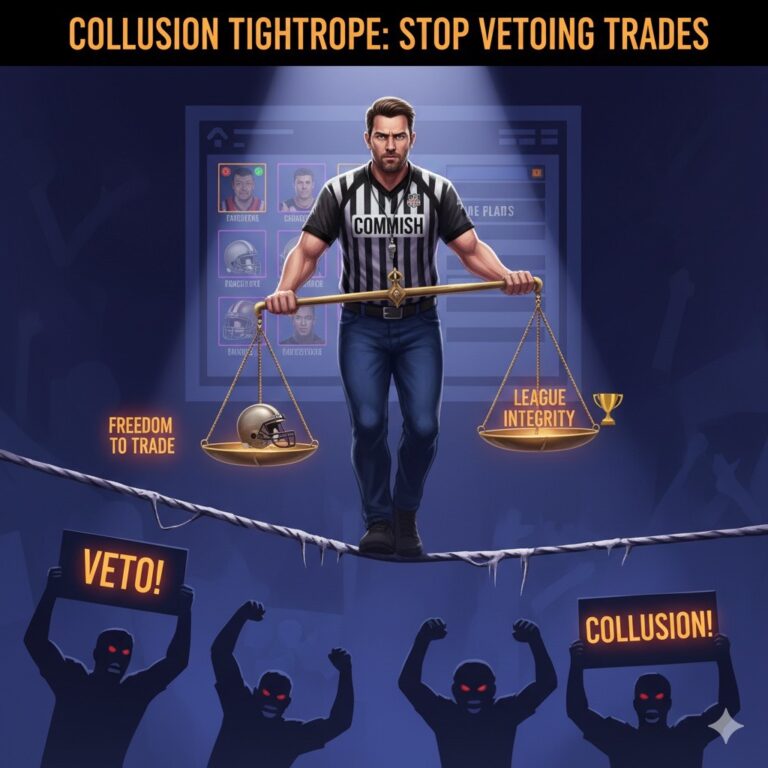
As fantasy commissioners, we’ve all been there: treading carefully while attempting to maintain trade freedom and league balance. The true fantasy commissioner cares about league integrity and longevity even, perhaps, more than his own team’s success.
So, how much control should a commissioner have, and what role should other owners play in regulating trades?
Let’s explore.
Introduction: The Veto, The Villain, and The Commish’s Curse
The notification pops up, the trade is accepted, and then, immediately, the chat erupts. There are screaming emojis, caps-lock arguments, and the inevitable, league-rattling demand: “VETO! That trade is league-breaking!”
Every fantasy league has a trade veto system, but almost every league misuses it. They turn the veto — a tool designed to protect the integrity of the game — into a weapon used to prevent opponents from improving. This is where the Commissioner steps onto the tightrope.
On one side, you have the cries for “freedom of team management” — the fundamental right of owners to make their own mistakes and bold moves. On the other, you have the collective voice demanding “league integrity” — the fear that one grossly lopsided deal could ruin the balance for everyone. Your primary duty isn’t to be the value police or to ensure every trade is “fair.” Your sacred, league-defining role is singular: preventing collusion. If you want a dynamic, fun league that actually trades, it’s time to abolish the flawed community vote and let the Commish rule with a swift, firm, and focused hand.
The Flawed Systems: Why the League Vote Kills Trading
When establishing a league’s rulebook, two systems for trade review dominate the conversation: the League Vote and the Commissioner Review. While the league vote sounds democratic, in practice, it’s nothing short of a tyranny of the majority.
This system, which typically requires a certain number of opponents to veto a deal before it’s overturned, forces owners to vote based on self-interest. You aren’t judging the trade’s fairness; you’re judging whether it makes an opponent better. If you’re a bubble team fighting for a playoff spot, you have every incentive to veto a trade that benefits two other contenders. This is why most League Vote systems end up killing the trade block, as active managers fear putting in the effort only to have their deals blocked by jealous rivals.
The solution is the Commissioner-Only Review. It centralizes power in one trusted, objective person, eliminating the group-think and bias that stagnate trade discussions. This approach ensures trades are approved quickly — usually immediately — unless they meet one very specific criterion.
Collusion vs. Fleecing: The Only Distinction That Matters
For a league to function, you have to accept a fundamental truth: A bad trade is not cheating.
The only legitimate reason for a commissioner to intervene is collusion. Collusion, by definition, is a secret agreement or conspiracy for fraudulent purposes. In fantasy sports, this means a deal where the exchange of players is not the core motivation.
Examples of True Collusion (Veto Required):
• The Side Deal: Team A trades a star player to Team B in exchange for cash, a favor, or a promise of a better draft pick next season.
• The Dumping: A manager who has given up on the season intentionally trades all their top players to a friend for low-value bench warmers to help that friend win the league (Bad-Faith Dumping).
• The Player Swap: Two teams trade back the exact same players every other week to cover bye weeks without improving either roster.
Examples of Fleecing (Allow to Stand):
• The Novice Owner: An inexperienced owner accepts an objectively lopsided deal because they don’t understand player values.
• The Stash vs. Win Now: A contending team trades a future draft pick (low present value) to a rebuilding team for a veteran star (high present value). Both teams benefit from their own strategy.
• The Hindsight Hit: A trade looks terrible on paper, but the “loser” correctly predicted a breakout or a major injury and ends up winning the deal long-term.
The Commish must be brave enough to look at a trade that seems ridiculous and ask: “Is this cheating, or just a massive error in judgment?” If it’s an error, you must let it stand. Owners must be allowed the freedom to manage their team, win or lose, based on their own valuation.
The Commissioner’s Mandate: Enforcing Integrity, Not Fairness
If you are the commissioner, you are the steward of the league’s integrity. Here is your mandate for managing the trade block:
1. Define Collusion Up Front: Before the draft, write a short “Trade Constitution” that explicitly states: “Trades are approved instantly unless suspected of clear, provable collusion, which involves an exchange of value outside the players/picks involved.”
2. Eliminate the Veto Button: If your platform allows it, disable the league veto entirely and switch to Commish Review Only. This is the fastest way to signal that only cheating is a fireable offense, not simply getting a better deal than the other guy.
3. Identify Red Flags: Always scrutinize trades involving teams that are mathematically eliminated from the playoffs, especially if they are trading away their best assets for injured players or assets that only benefit the contending partner. This often suggests collusion or bad-faith dumping.
4. The Ultimate Penalty: If you prove collusion, the response should not be simply reversing the trade. The penalty for cheating must be severe enough to deter it forever. The offending manager(s) should be immediately expelled from the league and forfeit their entry fee. This sends a clear, zero-tolerance message that protects the future of your league.
Conclusion: Setting the Rulebook Standard
The most destructive force in a fantasy league isn’t a bad draft pick or a string of injuries; it’s trade apathy, fueled by years of weaponized vetoes. If you take one lesson from this post, it’s this: A bad trade is not collusion. It’s an owner making a miscalculation or valuing their players differently than you do. You cannot, and should should not, police incompetence. You must only police cheating. If you want a thriving, active league, be bold: End the league-wide veto vote. Instead, establish a clear rule that trades are reviewed only by the Commissioner (or a trusted small panel) and will only be overturned for obvious, provable acts of collusion or bad-faith dumping. By clearly defining the line between a fleecing (allowed) and fraud (not allowed), you safeguard your league’s integrity while allowing the chaos, risk, and glorious fun of trading to flourish.