
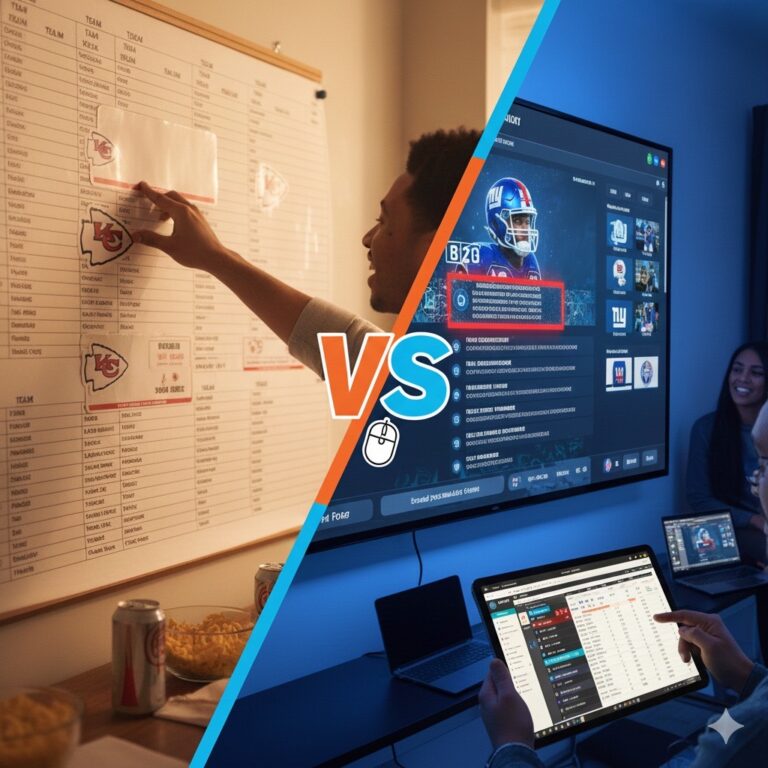
The fantasy draft is the best day of the year. It’s not just about selecting players; it’s about the noise, the camaraderie, the snacks, and that electrifying moment when you finally get to announce your first-round pick.
Every live draft needs a centerpiece—the monument to the chaos and strategy unfolding. For years, this meant a massive poster board covered in stickers. Now, commissioners face a critical decision: stick with the tried-and-true traditional paper board or upgrade to a sleek, modern digital display?
While both options offer unique benefits, the “best” choice depends entirely on your budget, the size of your party, and the desired atmosphere. Let’s break down the two main contenders.
The Case for Tradition: Paper Draft Boards
For many veteran leagues, the paper draft board is non-negotiable. It embodies the history and nostalgia of the game, delivering a pure, old-school draft day experience.
Pros (The Nostalgia Factor)
• Atmosphere & Theater: Nothing beats the satisfying rip of the sticker as you peel off Patrick Mahomes and the ceremonial slap onto the board. This physical act creates drama and makes every pick feel significant.
• Affordability: Paper boards are budget-friendly. You can usually find a full kit (board and player stickers) for less than the cost of a few pizzas, making it ideal for leagues looking to keep costs low.
• Reliability: You are entirely immune to technical problems. No Wi-Fi required, no HDMI cable failures, and no software updates to worry about. It just works.
• Souvenir: Once the draft is over, the finished board serves as an instant piece of league history. It can be photographed, framed, or hung in the commissioner’s garage as a trophy for the year.
Cons (The Manual Labor)
• Setup Time: Paper boards demand manual labor. You’ll spend time taping up the poster and sorting the hundreds of player stickers before anyone arrives.
• Mistakes: Human error is inevitable. Stickers can be dropped, misplaced, or placed in the wrong slot. Correcting these mistakes is messy and distracting.
• Tracking Challenges: The paper board is purely visual. It offers zero help with team needs, positional depth, or bye weeks. Commissioners must manually cross-reference picks with their online league host, adding an extra layer of administrative work.
• Portability: These things are huge. Transporting a 6-foot-tall poster board can be bulky and awkward.
The Case for Innovation: Digital Draft Boards
The digital draft board has emerged as the high-tech, high-efficiency alternative. It turns your draft room into a professional sports studio, providing seamless automation and a sleek visual experience.
Pros (The Efficiency Engine)
• Automation & Accuracy: This is the digital board’s superpower. As soon as a pick is entered into the connected tablet or laptop, the board instantly updates. This eliminates manual errors and automatically tracks positional eligibility.
• Visual Appeal & Dynamic Content: Digital displays can feature dynamic graphics, custom team logos, and sleek color schemes, elevating the overall presentation.
• Integration: Many digital platforms offer direct integration with major league hosts (like ESPN, Yahoo, or Sleeper). This means you can log a pick on the physical board, and it automatically registers in your online league.
• Customization: Need to change the display size or switch the color of the current picking team? Digital platforms offer endless customization options that are easily adjustable on the fly.
Cons (The Tech Hassle)
• Cost: Digital solutions require an investment. You need a large-screen TV or projector, a connecting device (laptop/tablet), and often a paid software subscription to access premium features like league integration.
• Technical Risks: If your Wi-Fi drops, your HDMI cable glitches, or the draft software crashes, your entire draft can grind to a halt. You are dependent on technical stability.
• Learning Curve: While modern interfaces are intuitive, some of the more advanced digital draft software requires the commissioner to spend time learning the setup and features beforehand.
Key Factors for Decision-Making (The Commissioner’s Checklist)
The choice ultimately comes down to what you prioritize for your league’s big day. Use these questions to guide your decision:
Party Size and Visibility
• The Problem: Can everyone clearly see the board?
• Recommendation: If you have a large party (8+ managers) spread out, a digital board projected onto a large screen offers immediate, clear visibility to all corners of the room. Small or intimate groups can easily manage with a central paper board.
Budget
• The Question: How much is the experience worth?
• Recommendation: If your budget is strictly limited or if you’re a brand-new league, the low-cost paper board is the clear winner. If your league funds allow for a software subscription and you already have the display equipment, go digital.
The Commissioner’s Role
• The Question: Do you want to host or manage?
• Recommendation: If you want to focus on hosting, socializing, and enjoying the party, paper is simpler (despite the sticker work). If you enjoy being the tech master and managing the draft flow with precision, digital is your preference.
League Experience and Atmosphere
• The Question: Are you prioritizing tradition or efficiency?
• Recommendation: Leagues that thrive on trash talk, tradition, and a casual environment often prefer the hands-on, tactile fun of paper. Leagues focused on data accuracy, professional presentation, and speed will love the smooth efficiency of digital.
Conclusion (Final Pick)
The battle between paper and digital boards reflects the broader clash of tradition versus technology in the fantasy world. Paper offers simplicity, nostalgia, and a tangible souvenir, while digital offers flawless efficiency, automation, and a dynamic presentation.
If you simply can’t choose, consider the Hybrid Approach: use the paper board for the dramatic, ceremonial placement of the player stickers, but keep a laptop or tablet running a digital tracker on the side to monitor team rosters and ensure accuracy. This gives you the best of both worlds!
Whichever path you choose, the energy of the live draft is what truly matters.