
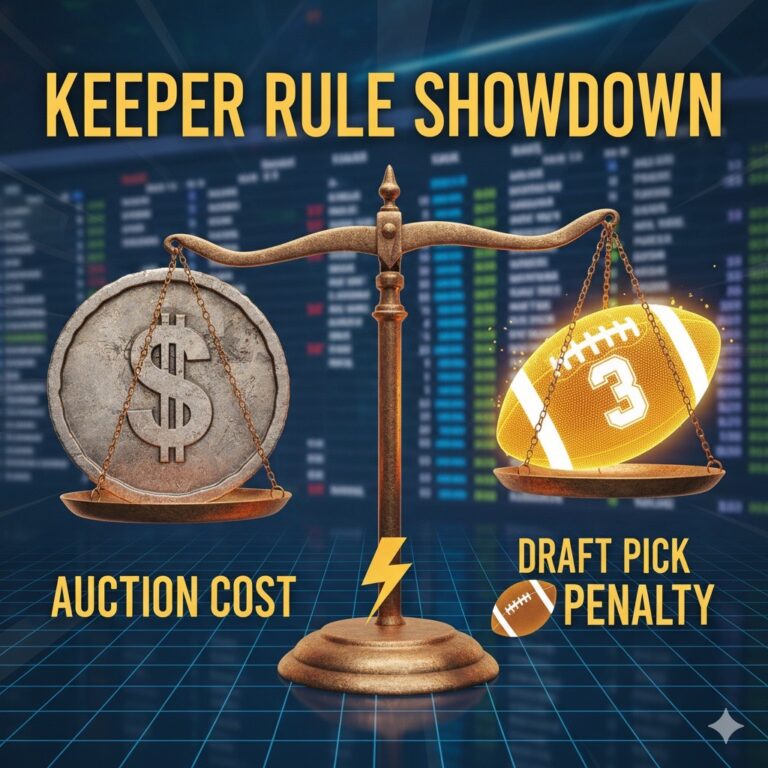
The Keeper Deadline Looms. The Clock is Ticking.
You hit the lottery: a late-round flyer or waiver pickup has blossomed into a locked-in starter.
You know you have to keep them, but the league rules are turning your golden asset into a tough accounting problem.
Is it worth sacrificing an early draft pick for the stability? Or is the calculated budget inflation costing you too much flexibility in the auction?
Your answer determines your entire draft strategy.
Introduction: The Eternal Keeper Quandary
You crushed your draft last year. You snagged a future stud in the late rounds — a 15th-round flier — or maybe you wisely picked up a waiver wire hero for $1. Now comes the moment of truth: you have a golden keeper opportunity, but the decision on who to keep and what to pay depends entirely on your league’s constitution.
In the world of keeper leagues, two formats dominate: the Draft Pick Penalty (DPP) system, where you forfeit a specific round pick, and the Auction Cost/Salary Cap System (ACS), where you spend an inflated dollar amount.
While both reward the manager who hunts value, the optimal strategy changes drastically based on whether your currency is draft capital (picks) or budget capital (dollars). Understanding this difference isn’t just about picking your best player; it’s about maximizing the currency you have left over to win the draft.
Format Deep Dive: Understanding the Mechanics
A. Draft Pick Penalty System (DPP)
This is the most common and often the simplest keeper format.
- How it Works: To keep a player, you forfeit the round where they were selected last year. Most leagues also implement a penalty, typically moving the cost up 1-3 rounds each subsequent year (e.g., a 10th-round pick becomes an 8th-round pick the following season).
- The Currency: Draft Position (Round Equity). Every pick, especially in the first five rounds, is a scarce resource.
- Key Pros: Simple to implement, encourages late-round drafting/waiver wire hunting, keeps early rounds competitive.
- Key Cons: Penalties are inflexible (a 6th-round pick is a 6th-round pick, regardless of market shift), can quickly make a player un-keepable.
B. Auction Cost/Salary Cap System (ACS)
This format turns your league into a mini-NFL, requiring managers to treat their draft budget like a salary cap.
- How it Works: A player’s keeper cost is their previous year’s auction price plus a mandatory inflation rate (e.g., +$5 or +20% of their salary). This cost is deducted from your total budget (e.g., $200) before the auction begins.
- The Currency: Auction Budget (Draft Dollars). Every dollar spent is a dollar removed from your cap.
- Key Pros: Allows for precise value calculation, managers can keep multiple high-value players if budget allows, creates “salary cap strategy” all season long.
- Key Cons: Requires more complex pre-draft math (especially calculating league inflation), forces managers to think about future cap space.
The Strategic Showdown: When to Keep and When to Release
The decision to keep a player should never be based solely on their name recognition. It must be a quantitative exercise in maximizing your draft currency.
A. Analyzing Players in a Draft Pick Penalty League
The only metric that matters here is the Round Advantage.
Strategy: Prioritize players whose current Average Draft Position (ADP) is significantly higher than the round they will cost you.
- The Gold Standard: If a player has a consensus 3rd-round ADP but only costs you an 11th-round pick, that is an 8-round advantage. This is the definition of a league-winning keeper.
- The Minimal Discount: If a player has a 5th-round ADP but costs you a 6th-round pick, the 1-round advantage is marginal. This keeper is almost never worth sacrificing the flexibility of your 6th-round pick, which could be used to trade for a future asset or take a high-upside rookie.
The Danger: Be ruthless. You must be willing to let a “good” player go back into the draft if their penalty is too high. Sacrificing a 4th-round pick for a player who will go in the 3rd or 4th is a poor use of capital, as it depletes your early-round options without providing a substantial competitive edge.
B. Analyzing Players in an Auction Cost/Salary Cap League
The metric that matters here is the Budget Surplus.
Strategy: Calculate the Dollar Value Surplus (Projected Market Value – Keeper Cost). Keep the players who give you the highest surplus, as this extra money can be leveraged to buy elite non-keepers.
- The Crucial Sub-point: Inflation. In an auction keeper league, every team is keeping high-value players for cheap, meaning that the total dollar value of the available players remaining in the pool is much higher than the total dollars remaining in the budget. This is league-wide inflation.
- Example: If your league’s inflation rate is 25%, a player valued at $40 will actually cost $50 in the open auction.
- Applying Inflation: A player you can keep for $60 (original cost + inflation) who has a projected market value of $75 might look like a $15 surplus. However, if you let him go, that $75 player might actually sell for $90 in the open auction due to inflation. By keeping him for $60, you gain protection from inflation and a true value of $30.
- The Danger: The “don’t overpay for a favorite” rule is paramount. If you drafted a player for $50 and can keep them for $55, but their projected value is only $58, you have almost no surplus. Those $55 dollars are better spent on a combination of two $20 players and a cheap starter, rather than locking in a minimal discount.
The Tiebreaker: Factors Beyond Pure Value
When you have multiple keepers who offer similar advantages, consider these secondary factors:
A. Roster Construction
Use your keepers to balance your spending. If you keep a $5 running back, you can focus on spending aggressively on two elite wide receivers in the auction, or vice-versa. In a DPP league, keeping three RBs in Rounds 10+ means you can wait until Round 7 or 8 to draft your first RB.
B. Positional Scarcity
Is the league RB-heavy? In a Draft Pick league, a cheap starting RB is priceless, even if the round discount isn’t huge. In an Auction league, RBs are often inflation-proof values.
C. Multi-Year Penalties
Does the cost escalate rapidly? A system that doubles the price or jumps 3 rounds every year means you must win now with that keeper before the penalty makes them unusable.
Conclusion: Know Your League’s DNA
The Keeper Rule Showdown boils down to one simple question: What currency are you trying to protect?
If you’re in a Draft Pick Penalty league, you are maximizing Round Advantage. If you’re in an Auction Cost league, you are maximizing Budget Surplus. Check your target players’ current ADPs and Average Auction Values (AAVs) now, run the numbers for inflation, and commit to the keeper decisions that give you the biggest, most flexible advantage.