
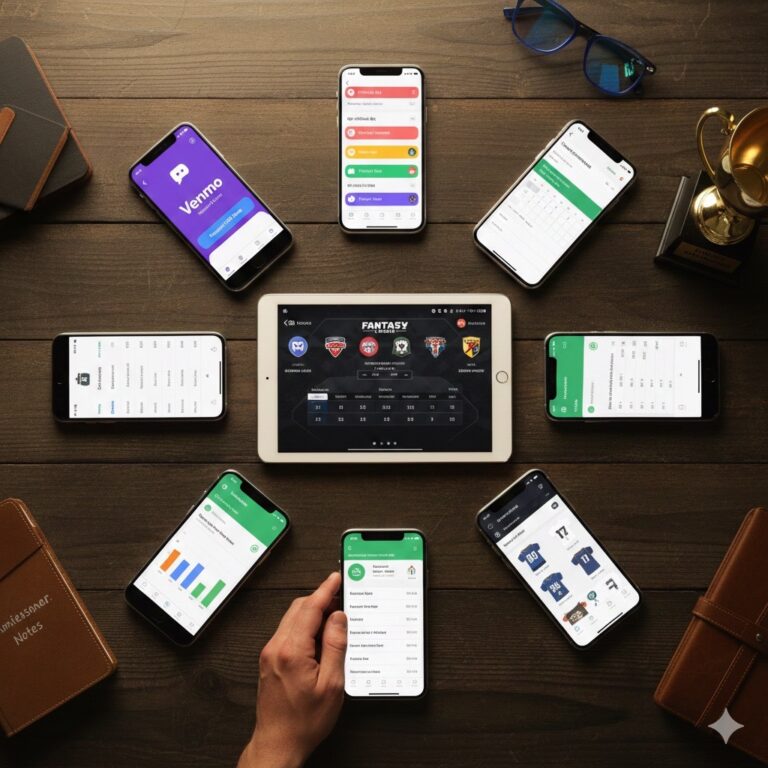
The role of a fantasy league commissioner demands organization and the right tools.
Whether you run a high-stakes fantasy league or manage a local sports team, having a streamlined system is key to avoiding burnout.
We break down the 7 must-have apps for effective league management, covering everything from dues collection and dispute resolution to communication and scheduling.
Introduction: The Commissioner’s Burden
Being a fantasy league commissioner is a labor of love—and often, a massive headache.
You are the ultimate leader: the chief executive who handles rules, the accountant who tracks the money, the historian who archives the records, and the mediator who settles the inevitable disputes over trades, schedules, or officiating calls.
It’s a role that demands organization, integrity, and a certain degree of benevolent dictatorship. But in the modern world of fast-paced communication and complex league formats (think Dynasty leagues, Keeper systems, or intricate local softball schedules), the traditional approach of using a spreadsheet, a group text, and a shoe box for cash simply won’t cut it anymore.
The problem is that commissioners often find themselves juggling five different platforms: the league host for scores, email for announcements, a group chat for trash talk, Venmo for dues, and a shared Google Doc that no one ever reads.
This chaos leads to commissioner burnout, confused league members, and disputes that could have easily been avoided.
The solution is simple: you need a streamlined, modern Commissioner’s Toolkit. By integrating seven specialized apps and tools, categorized by function, you can automate the administrative grunt work, enforce fairness with transparency, and spend less time chasing payments and more time enjoying the competition.
These are the 7 essential tools every modern league commissioner needs to run a smooth, drama-free, and highly engaging league, whether you run a high-stakes fantasy operation or a local recreational team.
The Core League Platform (App #1)
App 1: The All-in-One Host (e.g., Sleeper, TeamSnap, LeagueApps)
Your core platform is the foundation of your league. It’s where the games are played, the scores are updated, and the official records are kept. Choosing the right host is the single most important decision you will make, as it directly impacts your workload.
For fantasy leagues, look beyond the traditional options if you require custom features. Platforms like Sleeper have revolutionized the experience by blending deep customization (for complex rules like “Dynasty” or “Superflex”) with an excellent, integrated chat system. The best host should handle at least 80% of the statistical and transactional work automatically, minimizing the need for manual commissioner intervention. This includes automated scoring, waiver wire processing, trade acceptance, and real-time standings.
For local sports leagues (like soccer, basketball, or softball), look at robust tools like TeamSnap or LeagueApps. These systems handle team creation, roster management, facility booking, and, most importantly, automated scheduling and real-time score reporting, eliminating the commissioner’s need to manually update websites or spreadsheets after every game.
Why it’s essential:
The right platform should be a “set it and forget it” tool for the day-to-day operation. If you constantly have to manually fix scores or calculate standings, you have the wrong platform. Invest time in setting up the most customizable host upfront; it will pay dividends in time saved and reduced disputes later in the season.
Financial Tools (Apps #2 & #3)
Managing money is, statistically, the most common source of commissioner stress. Dealing with late payments, tracking expenses, and transparently handling the prize pool can turn a fun role into a part-time accounting job. The goal here is transparency and efficiency.
App 2: Dues Collection & Payouts (e.g., Venmo, Zelle, CashApp)
The days of collecting cash envelopes or checks are thankfully behind us. Utilizing a quick, direct peer-to-peer payment app is crucial for prompt fee collection and seamless prize distribution.
Why it’s essential:
The single most important rule for financial stability is the pre-season payment deadline. Your platform must make it incredibly easy for managers to pay before the first game or draft pick is made. Tools like Venmo or CashApp are universal, allowing players to transfer money instantly using their phone.
However, the commissioner must remain transparent. Use the app’s internal notes or a dedicated spreadsheet to track who paid and when.
Be firm: no payment, no draft slot. This tool doesn’t just collect money; it removes the friction and awkwardness of chasing down friends for cash, preserving league integrity. For payouts, the instant transfer capability ensures the champion gets their due without delay, ending the season on a high note.
App 3: Group Expense Splitting (e.g., Splitwise)
While the league dues and prize pool are straightforward, many leagues have shared expenses that fall outside the main pot—costs like trophy engraving, draft party catering, or buying equipment for a rec league team. This is where dedicated expense splitters shine.
Why it’s essential:
Splitwise (or similar tools) creates an immediate, transparent ledger of shared expenses. If the commissioner buys a new league trophy for $150, they simply log the expense in the app, select the members, and the app calculates who owes whom, ensuring everyone pays an equal share back to the commissioner (or whoever fronted the cost).
This removes the mental load of tracking small IOUs and provides an objective, auditable record for every shared expense. It ensures that shared costs are handled fairly, preventing resentment and keeping the focus on the game, not petty finances. This is the commissioner’s secret weapon for running a professional-level operation without ever having to say, “Hey, you still owe me $12 for the pizza.”
Communication & Engagement (Apps #4 & #5)
A successful league is built on two things: clear official communication and vibrant, unrestrained trash talk. The modern commissioner needs distinct tools to manage both.
App 4: The Real-Time Chat Hub (e.g., Discord, GroupMe, WhatsApp)
While many core league platforms have integrated chat, they often fall short on the organizational features needed for a deep, competitive league. A dedicated chat application like Discord or WhatsApp provides a crucial separation of communication channels.
Why it’s essential:
For the commissioner, the most valuable feature is the ability to create separate, organized channels or threads.
• #Official-Announcements: Used only for important deadlines, rule changes, or scheduling updates. No one is allowed to reply here. This ensures critical information is never buried under 50 messages about a bad waiver claim.
• #Trash-Talk: The main, chaotic hub where GIFs, memes, and rivalries thrive.
• #Trade-Talk: A dedicated space for trade discussion, which keeps league discussions organized.
This structure allows the commissioner to quickly broadcast crucial information that all members can easily find, drastically reducing the number of “When is the draft?” questions you’ll have to answer.
App 5: Scheduling the Draft/Season (e.g., TallyCal, Doodle Poll, Google Calendar)
Trying to coordinate the schedules of 8 to 12 busy adults for a single event, like a live draft or an end-of-season banquet, is the commissioner’s annual nightmare. A mass email or group text poll is inefficient and guarantees someone gets missed.
Why it’s essential:
Tools like Doodle Poll or TallyCal automate the availability process. You suggest 5–10 potential dates/times, and members simply click to mark their availability, instantly calculating the optimal time that works for the most people. This saves dozens of messages and avoids bias in selecting a time.
For in-season organization, a shared Google Calendar is invaluable. The commissioner can pre-populate it with critical deadlines: waiver cutoffs, trade deadlines, payment reminders, and playoff dates. Sharing this single, objective calendar link ensures everyone is looking at the same information, moving the argument away from “You didn’t tell me!” to “It’s right here on the calendar.”
Organization & Rule Management (Apps #6 & #7)
A league’s longevity depends on its constitution and the commissioner’s ability to enforce it fairly. These two tools provide the necessary governance and data backing.
App 6: The League Constitution Hub (e.g., Google Drive, Notion)
Every serious league, from fantasy to recreational, requires a written constitution—a set of bylaws that dictate rules, processes, and punishments. This document must be easily accessible and searchable.
Why it’s essential:
Using a collaborative document platform like Google Drive or Notion serves as the Single Source of Truth for all league governance.
• Accessibility: Place the full Constitution, scoring settings, and historical champion list in one document, and share a permanent, easy-to-remember link.
• Dispute Resolution: When a trade veto, roster submission issue, or other conflict arises, the commissioner simply points the players to the relevant section of the Constitution. This removes emotion from the decision, as the rule is objective and pre-agreed upon.
• History: Notion is particularly useful for tracking history, draft order methods, and keeper decisions year over year, reinforcing the league’s legacy. This tool helps the commissioner be a historian, not just a manager.
App 7: The Data Aggregator (e.g., FantasyPros Draft Wizard, Stat-specific Tools)
While your core platform handles the scorekeeping, a data aggregator helps you manage the integrity of the competition itself. This is particularly relevant for fantasy leagues that rely on trades and free agency.
Why it’s essential:
The commissioner’s least favorite duty is often trade review or vetoing a transaction. When is a trade collusion versus simply lopsided? Data aggregators provide an objective, expert-driven benchmark.
Tools like the FantasyPros Draft Wizard or specific stat sites for local sports can pull data from your host platform and provide consensus rankings, rest-of-season value, or player projections. For example, if a controversial trade is proposed, the commissioner can run the transaction through a tool that shows whether the exchange deviates wildly from objective expert valuation. Using this external, unbiased data allows the commissioner to make a ruling that is data-driven, rather than based on gut feeling, preserving competitive balance and keeping the league fair for everyone involved.
Conclusion: Automate & Enjoy
Congratulations, Commissioner. You now have a complete, seven-app toolkit designed to conquer the chaos of league management.
By using dedicated apps for specific administrative tasks—a core host for scores, Venmo for money, Discord for chat, and Google Drive for rules—you transform your league operation from a disorganized mess into a highly efficient, professional endeavor. Technology handles the structure; your leadership handles the culture.
The goal is to automate the mundane (chasing dues, finding a draft date, fixing simple errors) so you can focus on the fun parts: the trash talk, the legendary draft party, and fostering the community that makes the league worth playing in the first place. You are the conductor, and with these tools, your league will finally play in perfect harmony.
Now, go lead your league.
What is the single best app you use that wasn’t on this list? Share your essential commissioner tools in the comments and help your fellow C-Suite leaders!