
A fantasy football league is only as good as its prize structure. For the commissioner, setting the prize pool means balancing the lure of a massive championship jackpot against the crucial need to keep every manager engaged from Week 1 through the playoffs.
This choice isn’t just about money — it’s about maximizing participation, minimizing the dreaded “tanking,” and ensuring the league remains fun and competitive for all twelve managers, all season long.
It’s the ultimate Commissioner’s Dilemma.
Introduction
You’ve done the work: you crushed the draft, hit the waiver wire hard, and clawed your way to the top of your division. The final payoff is coming, but how will the winnings be split?
For years, the fantasy landscape has been dominated by the simplest model: winner-take-all, or a slightly kinder, top-heavy tier.
But as leagues have grown more competitive and buy-ins have increased, many managers are pushing back against a structure that leaves the majority with nothing.
How do you reward the champion without punishing everyone else?
This article dives into the biggest debate facing league commissioners today: How should prize money be distributed to keep leagues competitive and engaging for all managers throughout the season?
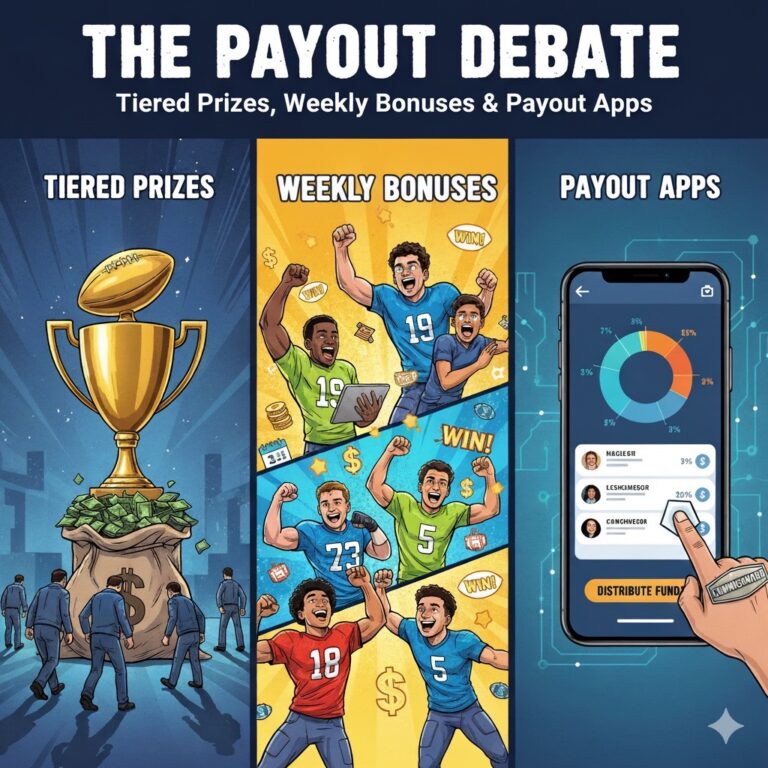
We’ll break down the pros and cons of traditional Tiered Prizes, the crucial role of Weekly Bonuses in maintaining engagement, and how modern Payout Apps make complex structures easier than ever to manage.
Tiered Prize Structures (The Traditionalists)
The tiered prize structure is the most common model in fantasy sports, and for good reason — it’s simple and effectively creates high-stakes competition.
Defining the Tiered Payout
In this model, the prize pot is divided into distinct percentages awarded based on final rank. The classic example is the top-heavy structure:
- 1st Place: 60% of the total pot
- 2nd Place: 30% of the total pot
- 3rd Place: 10% of the total pot
The Pros and Cons of the Tiered Prize Structure
Advantages (Pros):
- High-Stakes Excitement: The massive final prize pool means the championship game truly feels impactful.
- Focus on the Title: Rewards the manager who performed best when it counted — in the playoffs.
- Simple Accounting: Easy for the commissioner to calculate and distribute funds.
Drawbacks (Cons):
- Engagement Drops: Managers eliminated early in the season or barely missing the playoffs lose all financial incentive.
- “Tanking” Risk: Teams out of contention may stop setting their lineups or managing their roster, impacting playoff opponents’ schedules.
- Unfair to the Regular Season MVP: The manager who dominated the regular season can get knocked out in the first round of the playoffs and walk away with nothing.
Variation: Rewarding Regular Season Success
A popular modification to the traditional tier is to set aside a small payout for the regular-season points leader or the team with the best regular-season record.
This small adjustment helps reward year-long consistency and provides a valuable safety net for teams that performed well but suffered a bad playoff beat.
The Appeal of Weekly Bonuses (The Engagement Boosters)
If tiered prizes are about rewarding the ultimate champion, weekly bonuses are about sustaining manager commitment and keeping the league vibrant for 17+ weeks.
This structure allocates a defined portion of the league’s entry fees to smaller, periodic prizes.
Defining the Bonus Structure
Weekly bonuses are typically small cash prizes — often $10, $20, or $50, depending on the buy-in — awarded for a specific accomplishment each week.
Goal: To provide a financial incentive to managers who are currently out of the playoff race, or who simply had a fantastic week despite their team’s overall record.
The Pros and Cons of Spreading the Wealth
Advantages (Pros):
- Year-Long Engagement: Every manager has a chance to win something every single week, no matter their record, combating mid-season apathy.
- Skill Acknowledgment: Rewards managers who post massive scores but lose due to unlucky matchups.
- The “Re-Entry” Feeling: A small weekly win provides a boost and can feel like a new lease on the season, encouraging active waiver wire management.
Drawbacks (Cons):
- Reduced Grand Prize: Every dollar paid out weekly chips away at the final, high-impact championship pot.
- Complexity: Requires more diligent bookkeeping and prize tracking for the commissioner, especially in larger leagues.
- Minimal Impact: For high buy-in leagues, a small weekly bonus might not be enough motivation to outweigh the loss of the championship incentive.
Popular Examples of Weekly Bonuses
• Highest Weekly Score: The most popular bonus, rewarding the team that maximizes its scoring potential for that week.
• Biggest Margin of Victory: Rewards dominant performance, encouraging managers to play their studs regardless of opponent.
• Toilet Bowl Winner: A consolation ladder or playoff for the non-playoff teams, with a small prize to prevent bottom teams from tanking or ignoring their lineups.
The Role of Payout Apps (The Commissioner’s Friend)
The modern fantasy league features complex structures — a mix of tiered prizes, weekly payouts, and maybe even a few bespoke penalties (like paying for the “Worst Draft Pick”).
Trying to manually collect funds and distribute dozens of small payments is a nightmare. This is where dedicated Fantasy Payout Apps come in.
How Apps Streamline the Payout Process
While many leagues still rely on simple payment services like Venmo or PayPal, dedicated platforms like LeagueSafe or Splash Sports have become essential for leagues with higher stakes or complex payout rules.
• Hassle-Free Collection: Apps automate the collection of entry fees, saving the commissioner from chasing down payments. This allows the commissioner to focus on how to split the money, not if the money will be collected.
• Transparency and Security: They assure all managers that their funds are held securely by a trusted third party until the season ends. This increases trust, making managers more comfortable with higher buy-ins necessary for larger prize tiers and bonuses.
• Simplified Distribution: Apps allow the commissioner to easily input tiered percentages and weekly winner amounts for fast, accurate distribution. This makes running a hybrid model with frequent, small weekly payouts feasible without burnout.
Essentially, payout apps remove the biggest operational roadblock to running a creative, engaging, hybrid prize structure. They ensure the money is safe, tracked, and distributed according to the league’s pre-approved rules, no matter how complex the tiered system or how many weekly winners need to be paid.
Conclusion: Building Your Perfect Payout
The debate over fantasy payouts ultimately boils down to a conflict of philosophy: Is your league prioritizing the thrill of the mega-jackpot, or the value of year-long engagement?
The Hybrid Recommendation
For the vast majority of leagues — especially those looking for a competitive sweet spot — the answer lies in a Hybrid Model. A common split to consider is:
- 65-70% for the Tiered Prizes (1st, 2nd, and 3rd place).
- 30-35% allocated to Weekly Bonuses and potentially a regular-season points leader prize.
This model maintains a substantial, motivating championship purse while simultaneously ensuring that teams that get off to a 1-5 start still have a compelling financial reason to set their lineups and participate in waiver wire moves every week.
Final Takeaway
The best payout structure is one that motivates the middle of the pack and ensures no manager gives up mid-season.
If your league’s prize structure guarantees that eight out of twelve managers stop caring by Week 10, the money split is broken.
Use a combination of rewarding the champion and incentivizing weekly effort to keep your fantasy season competitive, engaged, and fun right up until the final whistle.